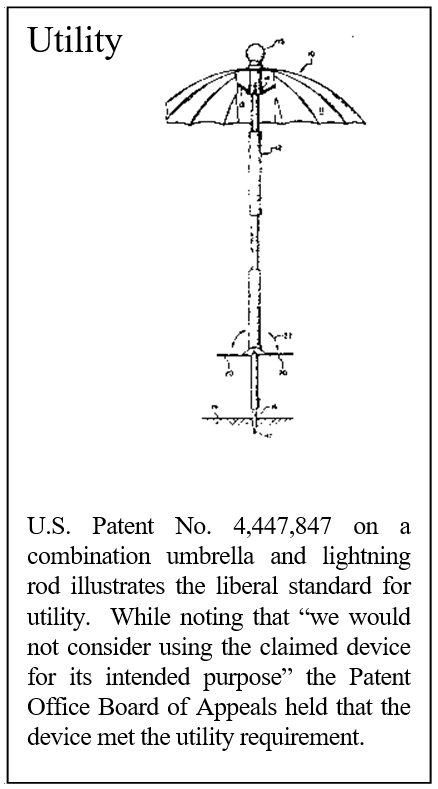
Despite the differences among the various national patent laws, the requirements for patentability are, at least nominally, very similar. Not all inventions are patentable. An invention must meet three principal requirements to be patentable: The invention must have utility; it must be novel; and it must be non-obvious. (Only the novelty and non-obviousness requirements apply to design patents). Utility simply means that the invention must be useful – most inventions easily meet this requirement. Novelty means that the invention must be new, i.e., different from what was previously known or used (the “prior art”). Non-obviousness means that in addition to being different from the prior art, the invention must be more than an obvious variation of the prior art. An invention is not patentable if it would have been obvious to a person of ordinary skill in the field of the invention, assuming that this hypothetical person was aware of all of the relevant prior art. Outside the U.S. the non-obviousness requirement is most often expressed as a requirement of an “inventive step” over the prior art. To qualify for utility model protection, the invention must still be novel, but the non-obviousness or inventive step requirement is usually relaxed. Patentability is judged objectively; it makes no difference whether or not the inventor actually knew about the prior art at the time the invention was made.
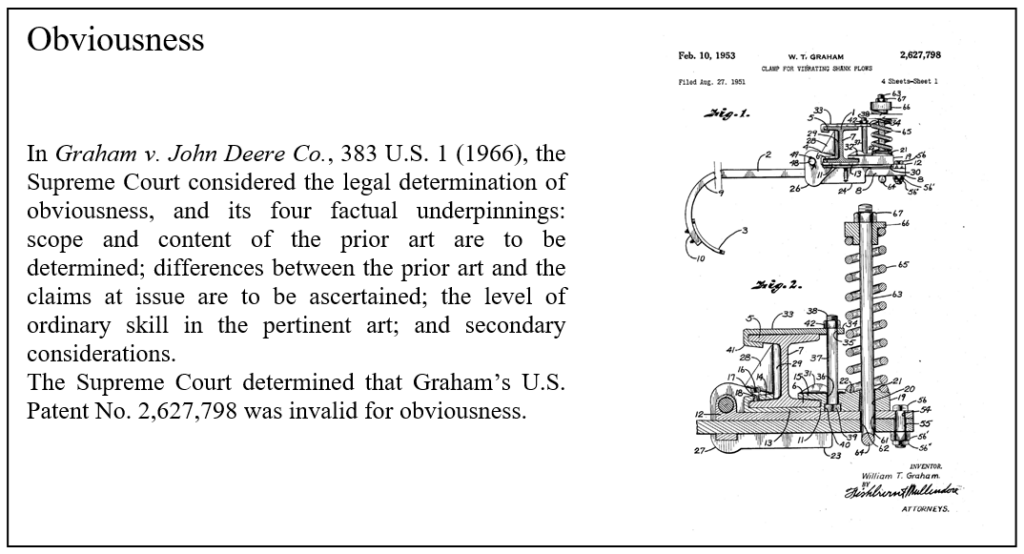
In deciding whether an invention is non-obvious, the Supreme Court held that four facts underlie the legal determination of whether an invention would have been obvious at the time the invention was made:
Under 103, the scope and content of the prior art are to be determined; differences between the prior art and the claims at issue are to be ascertained; and the level of ordinary skill in the pertinent art resolved. Against this background, the obviousness or nonobviousness of the subject matter is determined. Such secondary considerations as commercial success, long felt but unsolved needs, failure of others, etc., might be utilized to give light to the circumstances . . . surrounding the origin of the subject matter sought to be patented. As indicia of obviousness or nonobviousness, these inquiries may have relevancy.
In what was probably the greatest understatement in all of patent law, the Supreme Court said “This is not to say, however, that there will not be difficulties in applying the nonobviousness test. What is obvious is not a question upon which there is likely to be uniformity of thought in every given factual context.” However, the Court likened this other determinations that the courts must make: “The difficulties, however, are comparable to those encountered daily by the courts in such frames of reference as negligence and scienter, and should be amenable to a case-by-case development. We believe that strict observance of the requirements laid down here will result in that uniformity and definiteness which Congress called for in the 1952 Act.”
The Supreme Court revisited obviousness in 2007 in KSR International Co. v. Teleflex, Inc., — U.S. — (2007). The Supreme Court summed up the obviousness issue: “A court must ask whether the improvement is more than the predictable use of prior-art elements according to their established functions.” The Supreme Court held that there must be an “apparent reason” to a person of ordinary skill in the art to modify the prior art, and said that To determine whether there was an apparent reason “it will often be necessary to look to interrelated teachings of multiple patents; to the effects of demands known to the design community or present in the marketplace; and to the background knowledge possessed by a person having ordinary skill in the art.” The Supreme said that “any need or problem known in the field of endeavor at the time of invention and addressed by the patent can provide a reason for combining the elements in the manner claimed” (emphasis added). The Court further held that a person of ordinary skill is not limited to prior art related to the particular problem being solved, and said that a person of ordinary skill “is also a person of ordinary creativity, not an automaton.”
The Court gave some examples of what is obvious: “If a person of ordinary skill in the art can implement a predictable variation, and would see the benefit of doing so, §103 likely bars its patentability.” The Court also said that “if a technique has been used to improve one device, and a person of ordinary skill in the art would recognize that it would improve similar devices in the same way, using the technique is obvious unless its actual application is beyond that person’s skill.” Finally the Court noted that:
When there is a design need or market pressure to solve a problem and there are a finite number of identified, predictable solutions, a person of ordinary skill has good reason to pursue the known options within his or her technical grasp. If this leads to the anticipated success, it is likely the product not of innovation but of ordinary skill and common sense.
The Supreme Court concluded with a philosophical statement on the invention and obviousness:
We build and create by bringing to the tangible and palpable reality around us new works based on instinct, simple logic, ordinary inferences, extraordinary ideas, and sometimes even genius. These advances, once part of our shared knowledge, define a new threshold from which innovation starts once more. And as progress beginning from higher levels of achievement is expected in the normal course, the results of ordinary innovation are not the subject of exclusive rights under the patent laws. Were it otherwise patents might stifle, rather than promote, the progress of useful arts.
Whether an invention is patentable thus depends primarily upon how it differs from the prior art. The definition of prior art varies from country to country. In the United States, prior art includes anything previously known or used in the United States; anything previously patented or described in a printed publication anywhere; anything invented by another and not abandoned; and anything described in a patent application previously filed by another, which issues as a patent. The prior art also includes anything on sale, in public use, or described in a printed publication more than one year before the patent application is filed, including the inventor’s own work. Most countries also include as prior art anything made public before the effective filing date of the application, including disclosures by the inventor. The United States and Canada have a one-year grace period for public disclosures derived from the inventor, but most other countries do not. Thus, to preserve the ability to obtain patents outside of the United States and Canada, no disclosure of the invention should be made until after a patent application is filed.