TRACK 1 (PRIORITIZED EXAMINATION)
Prioritized examination is a procedure for expedited review of a patent application for an additional fee. The USPTO’s goal for prioritized examination is to provide a final disposition within twelve months of prioritized status being granted. •It is strongly recommended that applicants use the USPTO’s certification and request form PTO/AIA/424 to request prioritized examination, but the form is not required. The prioritized examination fee set forth in 37 CFR 1.17(c) is $4,000 for a non-small entity and $2,000 for a small entity. Prioritized examination is governed by 37 C.F.R. § 1.102(e).
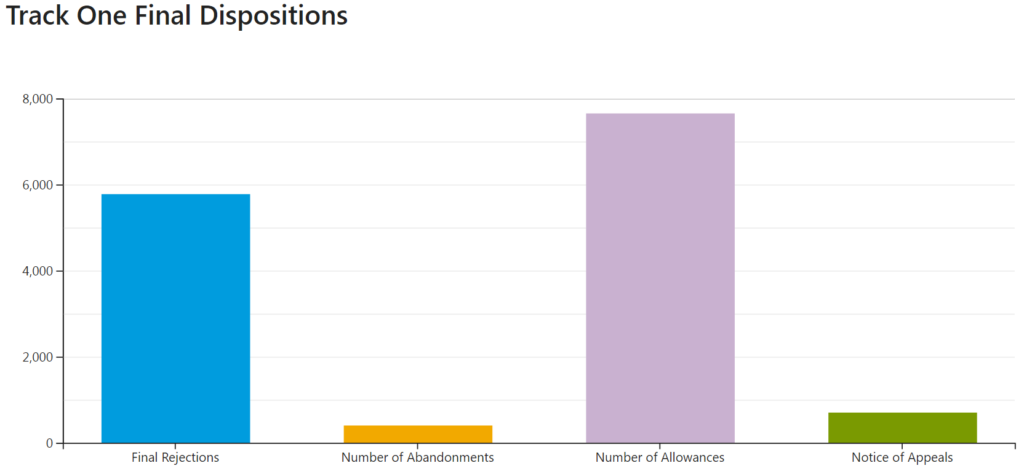
The average time from filing until the grant of the Track I petition is about 1.4 months, the average time from grant of the petition until the issuance of a first Office Action is about 1.1 month, and the average time from petition grant to final disposition of the application (allowance or final rejection) is 5.7 months. See USPTO Dashboard. The allowance rate is in 2021 is about 57%. See USPTO Dashboard.
ACCELERATED EXAMINATION BASED UPON INVENTOR AGE OR HEALTH
37 C.F.R. 1.102(c)(1) provides for a petition to make an application special based upon the inventors age (over 65) or poor health. The petition must be accompanied by any evidence showing that the state of health of the inventor or joint inventor is such that he or she might not be available to assist in the prosecution of the application if it were to run its normal course, such as a doctor’s certificate or other medical certificate. (Note that personal/medical information submitted as evidence to support the petition will be available to the public if the application file and contents are available to the public pursuant to 37 CFR 1.11 or 1.14, so if the applicant does not wish to have this information become part of the application file record, the information must be submitted pursuant to MPEP § 724.02. No fee is required for such a petition. See 37 CFR 1.102(c).
ACCELERATED EXAMINATION FOR INVENTIONS RELATING TO THE ENVIRONMENT< ENERGY SAVINGS, OR COUNTER TERRORISM
The U.S. Patent and Trademark Office will accord “special” status to all patent applications for inventions which materially enhance the quality of the environment of mankind by contributing to the restoration or maintenance of the basic life-sustaining natural elements, i.e., air, water, and soil. Applicants desiring to participate in this program should petition that their applications be accorded “special” status. Any petition to make special filed under this subsection must comply with the requirements set forth in MPEP § 708.02(a), and must state that special status is sought because the invention materially enhances the quality of the environment of mankind by contributing to the restoration or maintenance of the basic life-sustaining natural elements. If the application disclosure is not clear on its face that the claimed invention materially enhances the quality of the environment by contributing to the restoration or maintenance of one of the basic life-sustaining natural elements, the petition must be accompanied by a statement by the applicant, assignee, or an attorney/agent registered to practice before the Office explaining how the materiality standard is met. The materiality standard does not permit an applicant to speculate as to how a hypothetical end-user might specially apply the invention in a manner that could materially enhance the quality of the environment. Nor does such standard permit an applicant to enjoy the benefit of advanced examination merely because some minor aspect of the claimed invention may enhance the quality of the environment. No fee is required for such a petition. See 37 CFR 1.102(c).
The U.S. Patent and Trademark Office will accord “special” status to patent applications for inventions which materially contribute to (A) the discovery or development of energy resources, or (B) the more efficient utilization and conservation of energy resources. Examples of inventions in category (A) would be developments in fossil fuels (natural gas, coal, and petroleum), hydrogen fuel technologies, nuclear energy, solar energy, etc. Category (B) would include inventions relating to the reduction of energy consumption in combustion systems, industrial equipment, household appliances, etc. Applicants desiring to participate in this program should petition that their applications be accorded “special” status. Any petition to make special filed under this subsection must comply with the requirements set forth in MPEP § 708.02(a), must state that special status is sought because the invention materially contributes to the discovery or development of energy resources, or the more efficient utilization and conservation of energy resources. If the application disclosure is not clear on its face that the claimed invention materially contributes to category energy resources, the petition must be accompanied by a statement by the applicant, assignee, or an attorney/agent registered to practice before the Office explaining how the materiality standard is met. The materiality standard does not permit an applicant to speculate as to how a hypothetical end-user might specially apply the invention in a manner that could materially contribute to energy resources. Nor does such standard permit an applicant to enjoy the benefit of advanced examination merely because some minor aspect of the claimed invention may be directed to energy resources. •No fee is required for such a petition, 37 CFR 1.102(c).
The U.S. Patent and Trademark Office will accord “special” status to patent applications for inventions which materially contribute to countering terrorism. International terrorism as defined in 18 U.S.C. 2331 includes “activities that – (A) involve violent acts or acts dangerous to human life that are a violation of the criminal laws of the United States or of any State, or that would be a criminal violation if committed within the jurisdiction of the United States or of any State; and appear to be intended – (i) to intimidate or coerce a civilian population; (ii) to influence the policy of a government by intimidation or coercion; or (iii) to affect the conduct of a government by assassination or kidnapping…” The types of technology for countering terrorism could include, but are not limited to, systems for detecting/identifying explosives, aircraft sensors/security systems, and vehicular barricades/disabling systems.
All applicants desiring to participate in this program should petition that their applications be accorded special status. Any petition to make special filed under this subsection must comply with the requirements set forth in MPEP § 708.02(a), stating that special status is sought because the invention materially contributes to countering terrorism. If the application disclosure is not clear on its face that the claimed invention is materially directed to countering terrorism, the petition must be accompanied by a statement by the applicant, assignee, or an attorney/agent registered to practice before the Office explaining how the invention materiality contributes to countering terrorism. The materiality standard does not permit an applicant to speculate as to how a hypothetical end-user might specially apply the invention in a manner that could counter terrorism. Nor does such standard permit an applicant to enjoy the benefit of advanced examination merely because some minor aspect of the claimed invention may be directed to countering terrorism. No fee is required for such a petition. See 37 CFR 1.102(c).