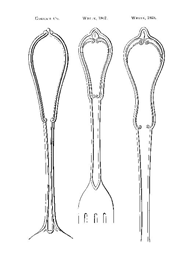
Infringement of a design patent is determined by comparing the design patent’s drawings and the appearance of the accused product. If, in the eye of an ordinary observer, giving such attention as a purchaser usually gives, the resemblance between the two designs is such as to deceive such an observer, inducing the observer to purchase one supposing it to be the other, then the patented design is infringed. This test was announced by the Supreme Court Gorham Mfg. Co. v. White, [1]where the Supreme Court found that Whites two patented designs for flatware handles infringed Gorham’s previously patented design:
For a design patent to be infringed, however, no matter how similar two items look, the accused device must appropriate the novel appearance in the patented device that distinguishes it from the prior art. While minor differences between a patented design and an accused article’s design will not prevent a finding of infringement, where the patented device and the accused device are no more similar to each other than to the prior art, there is no infringement. This simply means that where a field is crowded with many references relating to the design of the same type of article, the scope of the patent is construed narrowly.
[1] 81 U.S. 511 (1871).