An EPC application is a single application filed in the European Patent Office, that designates one or more members of the twenty-eight members of the European Patent Convention: Austria, Belgium, Republic of Bulgaria, Cyprus, Czech Republic, Denmark, Estonia, Finland, France, Germany, Hellenic Republic (Greece), Hungary, Ireland, Italy, Liechtenstein, Luxembourg, Monaco, Netherlands, Poland, Portugal, Republic of Romania, Slovak Republic, Slovenia, Spain, Sweden, Switzerland, Turkey, United Kingdom. In addition, there are provisions for extending the effect of a European Patent into certain non-member countries: Albania, Lithuania, Latvia, and Macedonia.
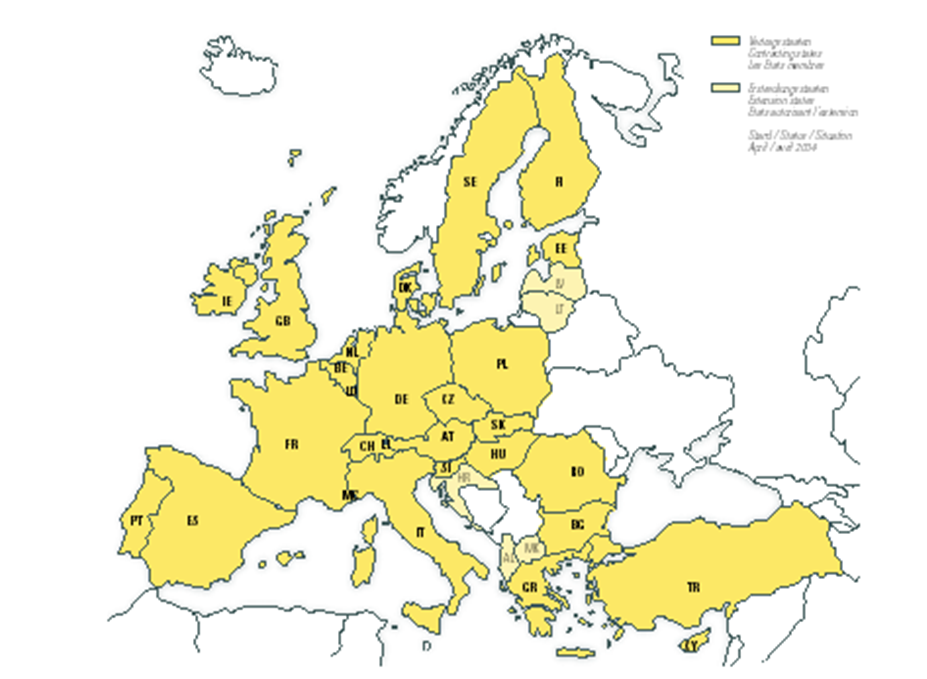
The advantages of an EPC application are:
- Only one application need be filed and prosecuted to obtain patent protection in up to eighteen countries.
- The application can be filed and prosecuted in English, saving translation expenses until it is known whether a patent will issue.
The disadvantages of an EPC application are:
- The cost is fairly high, unless patent protection is sought in at least three to five countries.
- The decision of patentability for all of the countries designated rides on the determination of the European Patent Examiner.
After prosecution in the European Patent Office, individual patents issue on each of the countries designated in the application. Each issued patent stands alone, and is controlled by the issuing country’s national laws.
U.S. firms are increasingly availing themselves of the EPC system. In 2020 U.S. nationals filed 44293 of the 180250 EPC applications filed, or 24.6% of the total
In 2020, 59.2% of EPO filings are based on a prior PCT application, and about two-thirds of US EPO applications are based on a prior PCT application.